













Think about the teachers you’ve had at BHS. How many female PE teachers can you name? How many male World Language teachers have you had?
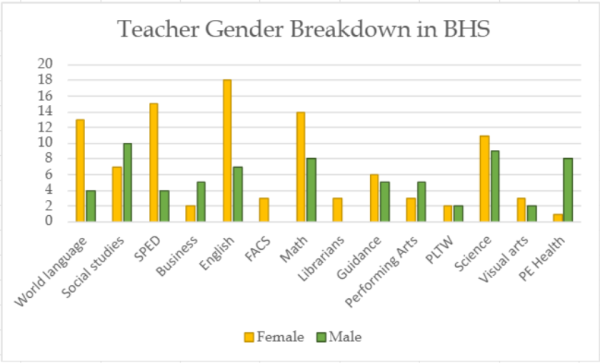
Overwhelmingly, education has been a female-dominated field, though this divide has become less pronounced in recent years. Here at BHS, the English department has seven male teachers and 18 female teachers. This difference is even more staggering in World Languages, with 13 female teachers and only four male ones.
However, the pattern shifts in other departments. In Business, there are five male teachers and only two female teachers, and in PE there are eight male teachers and just one female teacher. Why are some fields more male-dominated while others are more female-dominated? What effects might this have on students?
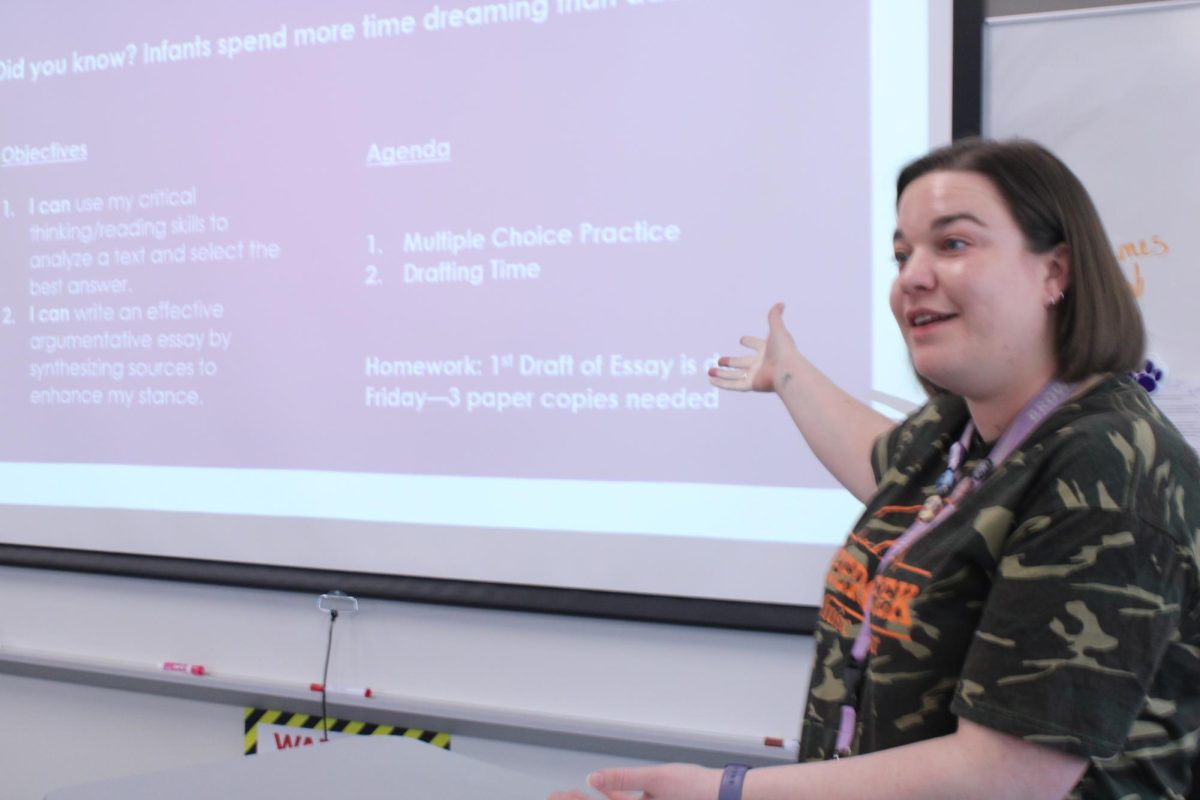
“I think specifically for English, there is sort of a perception that because English doesn’t necessarily have an objective right answer all the time, and there’s more nuance and that sort of thing, I do think there’s sort of an attitude of that men don’t like it, or that it’s not for them,” English teacher Kate Wisely said.
While some people believe this issue no longer exists in schools, national statistics suggest otherwise. According to the Pew Research Center, women make up 72% of middle school teachers and 60% of secondary or high school teachers.
“I feel as if there’s still a stereotype that circles around education as a profession… a lot of males don’t necessarily see education beyond a ‘pink-collar job,’” English teacher Daniel Duran said.
For many years, research has shown teaching as an extension of mothering. Because women have historically been perceived as more nurturing, society often viewed them as naturally suited for teaching roles. These expectations helped reinforce the stereotype that education was a “natural” profession for women.
Understanding the roots of these stereotypes helps explain why certain gender norms persist today. Many students rarely see teachers of their own gender in some subject areas. For example, a female student might rarely see women teaching higher-level STEM courses, while male students might rarely see men teaching humanities classes.
“If you’ve never seen somebody like you do it, then you don’t know that’s an option for you,” Wisely said.
One argument for this divide is that fewer women apply for certain positions, particularly in areas like physical education or coaching.
Some researchers argue that traditional gender expectations continue to reinforce these imbalances. Historically, women have often been expected to prioritize marriage and raising children, which can make demanding careers more difficult to pursue. This can create real-world obstacles in fields like PE, where coaching responsibilities often require long hours outside the school day. During the season, some coaches may work upwards of 60 hours a week.
“A lot of our PE teachers are coaches… and coaching requires a lot of out-of-school hours,” PE teacher Julie Waggoner said.
Many people question why these conversations matter. However, examining these patterns can help challenge long-standing stereotypes about who belongs in certain fields.
“I think students honestly want to feel like they have opportunities,” biology teacher Christy Heldman said.
Women in STEM
In recent years, there has been a strong push encouraging girls to pursue STEM fields. Scholarships and programs emphasize breaking barriers and addressing biases that have historically discouraged women from entering science and technology careers. Women in STEM face a myriad of biases and stereotypes that create pay disparities and enforce the lack of representation in leadership. Compared to their male counterparts, the odds are stacked against them.
Directly or indirectly, women are pushed away from STEM at a young age, so the women in the STEM movement have advertently helped change some of the psychological biases placed on children that might deter girls from STEM professions.
However, unlike STEM fields, there has been far less discussion about encouraging men to enter humanities and education careers. Currently, many humanities and language departments remain overwhelmingly female-dominated.
As conversations about gender representation continue, some educators believe schools should encourage students to pursue subjects outside of the traditional stereotypes. By exposing students to a wider range of role models and career paths, schools may help break long-standing stereotypes about who belongs.
“Our student population is getting more and more diverse… and I think our teachers should reflect our students,” Duran said.
