
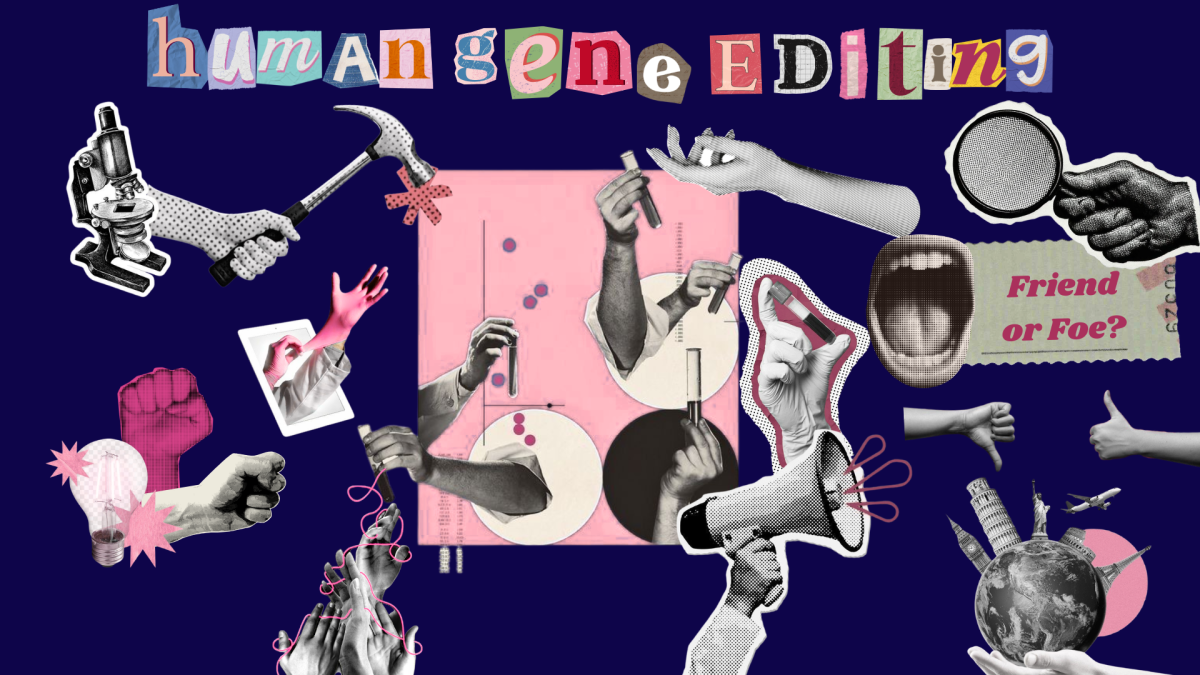




















In 2018, Chinese biophysicist He Jiankui announced his ability to genetically alter embryos to be resistant to HIV/AIDS. While the effectiveness of this has not been fully proven, ever since the first genome-edited babies, scientists have posed the question: could human genetic editing be the advancement of the future? Ethical concerns such as the resurgence of eugenics are considered by many with these new advancements.
The gene editing technology that was used by He to achieve gene-edited embryos is CRISPR. CRISPR is the landmark technology for editing human gene sequences.
“The CRISPR editing tool will enter the cells of every cell in your body, and it’s like a little pair of scissors that will cut out a sequence that it’s looking for and then replace it with something else,” science teacher Jessica Petersen said.
CRISPR made the gene editing process faster and allowed for targeting specific genes. Following the publishing of He’s experiments, the scientific community was shocked. Bioethics professor Jing-Bao Nie shares this sentiment.
“My initial response was shocked because that was clearly a breach of the guidelines by that time, international consensus, ethical consensus,” Nie said.
He’s gene-edited embryos caused large conversations within the scientific community because it had never been done before.
The possible resurgence of eugenics has been a recurring fear within the scientific community. Eugenics is often considered the idea that people attempt to “improve” the genetic composition of a population. The lack of regulated CRISPR use on human embryos and the history of science being used to promote eugenics creates uncertainty.
“The main long-term risk is unintended consequences,” Nie said. “We cannot foresee those possible risks. It’s not good enough to really predict at this moment.”
Within the many conversations being had by scientists, the question of whether humans should have such power over humanity has been asked frequently.
“If we do find something that’s favorable or going to shorten their life or make it a worse quality of life, if [gene editing] allows it, how moral is it to go in and change it?” junior Elizabeth Perry said.
Genetically engineered traits are a huge concern for humanity as it could result in a lack of genetic diversity within humans.
“Well, if this virus comes in that attacks this gene, and everyone has a gene, everyone’s dead; variation is how sometimes you survive,” Petersen said. “You survive because it’s the survival of the fittest.”
Due to human gene editing still being in its initial stages, many scientists push for limitations and guidelines around its use to prevent unintended consequences.
“Guidance is not sufficient … I would say, yes, guidelines are very important, but [the] scientific culture of the scientific community is also very important, including more general public discussion,” Nie said.

