







Five days a week and almost 20 hours in total—that is the amount of time the robotics team, Team 3176, spends working together after school to prepare for its competition season that started March 8, 2026.
Every year, the season starts with an event called “Kickoff” where the competition theme and robot-building requirements are released to the competing schools. Teams then follow these guidelines when creating their robot, which needs to complete different tasks at the competitions. This theme release commences an eight-week period where the team meets every day through the week, except for Wednesdays and Sundays, to build and test their robot.

The robot has been designed to shoot a ball into a hoop, as stated by the requirements from Kickoff. Photo by Oyinkansola Ojo.
Story continues below advertisement
“So, at that point, [competition organizers] release a rulebook several hundred pages long, and the team starts to digest what is the game, how to play it, and then start to understand what’s most important,” Jim Lang, controls team mentor, said. “And that starts to lead us down a design path.”
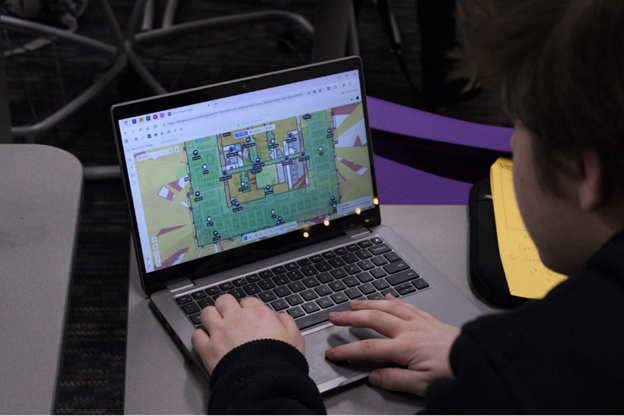
The sub-team, controls, focuses on the actual building and controlling of the robot. They deal with going through the rules provided to them, and they then begin building the robot once the design sub-team decides what the robots needs to look like. They also write and implement all the electronics for the final robot.
“Right now, we’re working on going from just the design and ideas to a fully-fledged functional robot,” senior Andrew Pepmeier, chief engineer of technical team, said. “And so right now, we’re just working on getting the updates that we’re going to do to the robot before we start and then installing those and getting the robot ready to go on Thursday.”
The design team produces the ideas of what the robot should look like and the elements it must include in order to complete the task, shooting a ball through a hoop. The controls team then brings these elements to life.
“I’ve been electrical lead for three years,” senior Audra Hagerman, electrical lead of the controls team, said. “So, my main thing is I oversee all the wiring on the robot and all the electrical tasks that need to happen in general.”
Once the robot has been built and programmed, the controls team begins testing the robot. They continue testing, making adjustments and retesting.
While all the controls team is building and testing, the business and social media teams are also preparing for competition, reaching out for sponsorships, awards and completing paperwork.
“The organizers of the entirety of the Robotics League, every year, update [award opportunities] on their website,” junior Ava Vashistha, business operations manager said. “We try to get higher in rank and win awards.”
Despite being separated in the sense that the teams work in separate areas, they still gather together. They have meetings at the end of all their practices to discuss what each team has accomplished.
“[We] make sure the robot actually gets built because design doesn’t necessarily know what controls can deliver,” senior Liam McNeely, project manager for the entire team said.
Due to all their hard work and time put into their build season, the team and their members feel prepared for their competition season.
“It is stressful,” Hagerman said. “There is a lot of work that we need to get done, but as long as you know what you’re doing, or if you have people above you who know what they are doing, everything will be fine.”